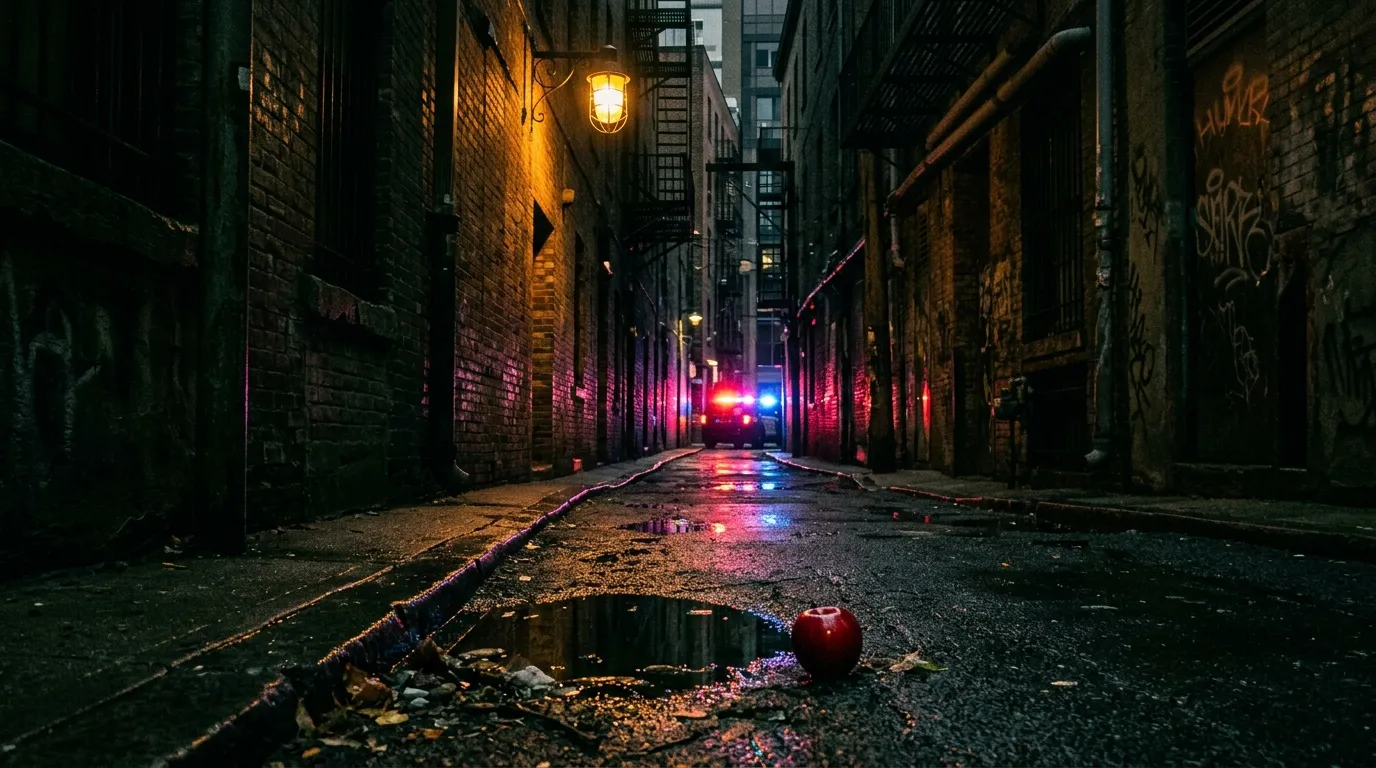
The sirens came too late to matter.
By the time their wail cut through the narrow, dark alley, the boy had already made his decision. He stood beneath a flickering streetlight, its erratic glow casting him in alternating bands of shadow and pale yellow light. He did not try to hide. He did not run. He simply waited, as though the outcome had already been calculated and accepted.
He looked younger than the moment required—thin shoulders swallowed by an oversized hoodie, dark hair clinging damply to his forehead, a streak of dirt cutting across his cheek like a careless mark. Thirteen, perhaps. Young enough that, under different circumstances, someone might have told him to go home, wash his face, and finish his homework before bed.
But there was nothing careless about the way he held himself.
His stance had been perfected by repetition until each movement worked with the precision of a well-tuned machine. The blare of sirens did not rattle him. The scrape of windows sliding open above the alley, the curious faces peering down from shadowed apartments, the far-off bark of a dog, the pounding footsteps of officers closing in—none of it seemed to touch him. His fixed stare registered every detail without reacting to any of it. He had been trained to remain emotionless, trained to keep his body obedient, trained to understand that fear was weakness and hesitation a defect.
A defect could be corrected.
He knew that.
He had known it even before the shot.
The man had been walking home from work, lunch bucket swinging loosely from one hand, head bowed as if the weight of the day still clung to his shoulders. He had cut through the alley because it was faster. People always chose what was faster, what was familiar, what felt safe. That was how weakness announced itself.
The boy had been waiting in the darkness near the dumpster, where the shadows thickened and the stink of old grease and sour garbage masked the metallic scent of gun oil. His hands had not trembled as he lifted the weapon. His breathing had slowed, just as he had been taught. He had fixed his eyes on the center point and remembered the words exactly as they had been drilled into him.
Still the mind. Still the hand. Purpose is greater than pity.
The man had heard something then, perhaps the faint scrape of a shoe, and turned halfway around. His mouth opened, but no plea had time to form.
The boy squeezed the trigger.
The force kicked into his arms. The sound cracked through the alley and vanished into the city night. The man’s body jerked once, then collapsed in a graceless heap against the dumpster, his lunch bucket rolling away and spilling its contents into a shallow rain puddle—an apple, a wrapped sandwich, a thermos denting the concrete before settling on its side.
The boy had not moved toward him. He had only looked.
One shot. Centered. Efficient.
A clean act.
A successful act.
A feeling close to achievement moved through him, not joy exactly, not excitement, but the quiet satisfaction of having completed an assignment properly. Dominus had said the weak clung to remorse because they mistook emotion for morality. The strong understood purpose.
He had whispered the final line under his breath as the man bled out at his feet.
“I act. I do not fade.”
Then the sirens had begun.
Now, in the harsh interruption of flashing lights and shouted commands, he waited beneath the streetlamp as if the next sequence had already been written.
When the first officer rounded the corner, weapon raised, the boy responded instantly—not with panic, but with precision. His hands lifted to shoulder height, fingers spread wide, elbows locked in place as if he had practiced the motion until it required no thought at all.
“Hands where I can see them!” the officer barked, though the command had already been obeyed.
The second officer slowed just behind him, eyes narrowing as he took in the scene. The boy’s stillness was what unsettled him—not defiance, not fear, but something far more deliberate. Kids cried. Kids bolted. Kids begged. They did not stand under a streetlight like soldiers awaiting inspection.
“Step forward,” he said. “Nice and easy.”
The boy complied, taking three measured steps before stopping exactly where the light pooled brightest. No hesitation. No extra movement. It was as though an invisible boundary had been drawn beneath his feet.
Officer Russ Delaney exchanged a look with his partner, Miguel Ortega. Russ had been on the force for nineteen years. He had seen gang initiations, drugged-out teenagers, domestic fights turned bloody, a father who had left his infant in a car in August heat. But this was different. This kid looked too composed, too emptied out. It was the face that bothered him most. No tears. No confusion. No desperate searching for an adult to explain things.
Miguel saw it too, but what he felt first was not anger. It was dread.
His own son had turned thirteen three months earlier. He had spent the afternoon arguing with him over algebra homework and screen time, both of them pretending irritation while his wife laughed from the kitchen. This boy standing in the alley had that same awkward hinge of youth in his shoulders, that same unfinished shape. But somewhere along the line, whatever should have made him a child had been stripped away.
“Name?” Russ demanded.
The boy tilted his head slightly, considering the question in a way that felt less like confusion and more like evaluation.
“My designation is Hawk,” he said.
The word landed strangely in the air between them.
“That’s not your name, son,” Russ replied, his voice tightening despite himself.
For a moment, the boy said nothing. His gaze drifted past them, scanning the alley behind their shoulders, as though he were tracking something they could not see. When he spoke again, his tone remained calm, almost indifferent.
“That name is no longer in use.”
Miguel felt the tiny muscles in the back of his neck tighten.
“Alright,” he said carefully. “We’ll sort that out. Just stay where you are.”
The boy did not move. He barely seemed to breathe.
Russ gestured with his chin. “Cover me.”
Miguel kept his Glock trained on the boy while Russ moved deeper into the alley, sweeping the beam of his flashlight across wet pavement, brick walls scarred by graffiti, overturned crates, and mounds of black plastic garbage bags split open by rats or stray cats. A trail of something dark glistened on the concrete.
Then Russ saw the lunch bucket.
It rested on its side near the dumpster, handle bent, sandwich wrapper partly undone as though a hand had released it in surprise. His flashlight slid upward, and his stomach lurched.
“Cuff him,” he shouted. “We have a body here.”
Miguel did not take his eyes off the boy as he reached for the handcuffs. “Turn around.”
The boy obeyed with the same eerie precision, offering his wrists without resistance.
Russ climbed partway over the broken crate leaning against the dumpster and forced himself closer. The body lay twisted in an impossible angle, one arm trapped beneath the torso, the other flung outward. Blood had already begun to thread its way through the seams of the concrete. The man’s eyes were half-open, fixed on nothing. The bullet hole centered between them made the face look less murdered than erased.
Russ swore under his breath.
Next to the corpse lay a weapon and, a few feet away, an empty shell casing that caught the flashlight beam like a tiny brass eye. He stared at the gun, then back at the boy standing in cuffs under the streetlight, and something hot and immediate surged through him. He had worked homicides before. He knew what he was looking at. This had not been panic fire. This had been execution.
“What used to be a man walking home from work,” he muttered bitterly, “and this kid did it like target practice.”
The boy heard him. A faint sensation of pride stirred inside his chest.
A clean act. A worthy act. Advancement through obedience.
But beneath that satisfaction, something else moved—small and unwanted. His eyes dropped, almost involuntarily, to the spilled apple near the dead man’s hand. Red skin. One bruised side. A shape so ordinary it struck him with sudden force.
A kitchen table flashed through his mind. A woman’s hand cutting apple slices. Sunlight on yellow curtains. A voice saying, Carter, don’t run inside the house.
The image hit and vanished so fast it left no trail except a violent tightening in his throat.
I am not who I was.
The line rose in him like a command.
I am what I am made.
The sirens grew louder, their red and blue lights beginning to wash over the alley in pulsing waves. When the color struck his face, something changed—not outwardly, not enough for certainty, but just enough to suggest recognition. It flickered there for a fraction of a second and then disappeared, leaving the same composed stillness in its wake.
“Do you understand why you’re being detained?” Russ asked as he returned, fury simmering beneath each word.
“Yes,” the boy replied.
“Then tell us what happened.”
This time, when the boy lifted his eyes, he looked directly at Russ—not with hostility, not with remorse, but with a quiet, unsettling focus.
“You were not the intended targets,” he said.
The words settled heavily in the confined space.
Miguel’s voice sharpened. “What did you just say?”
The boy’s expression did not change, but something in his posture seemed to close, as though a door had been quietly shut.
“You arrived ahead of sequence.”
Russ felt his pulse hammering in his temples. “What sequence?”
The boy looked beyond him again, almost annoyed by the need to explain.
“The next action. You interrupted the next action.”
Behind them, a radio crackled to life, voices overlapping, urgent and disjointed. More units were arriving. More confusion. The situation was expanding beyond the narrow limits of the alley.
The boy lowered his gaze slightly, and for the first time there was the faintest suggestion of disappointment.
“You’re too early,” he said.
Miguel drew a slow breath and tried again, softer this time. “Kid, listen to me. Whatever somebody told you to do, whatever game they put you in, it’s over now. You hear me? You’ve got a chance to help yourself.”
For a brief instant the boy’s eyes shifted, not with fear, but with something closer to puzzlement, as if the word help belonged to a language he no longer trusted.
Russ stepped forward, closing the distance with practiced efficiency. The metallic snap of handcuffs echoed sharply as they locked around the boy’s wrists.
“This is over,” he said, more firmly than he felt.
For the first time since they had entered the alley, the boy looked directly into another human face.
And then he smiled.
It was not wide or wild, not the smile of a child caught in something he didn’t understand. It was small, controlled, and certain.
“No,” he said quietly.
“It isn’t.”
The words landed somewhere deep and foul in Russ’s gut. The kid showed no remorse, no fear of consequences, no instinctive deference to the authority standing inches from him. He stood there in cuffs, thin and filthy and not much bigger than Russ’s own nephew, smiling under conditions that should have rendered him terrified.
Russ felt bile rising in his throat.
“Listen, kid,” he snapped, grabbing a fistful of the boy’s hoodie and jerking him forward. “You’re in deep shit. That body over there—is that your work?”
The boy’s eyes remained steady. “What’s done is done. Dominus knows all. He requests, I deliver. I am saved.”
Russ tightened his grip. “Yeah? Who’s Dominus?”
“The knower. The great one.” The boy’s voice took on an almost reverent calm. “Dominus protects those who do great things. I serve Dominus.”
“Dominus,” Russ repeated with contempt. “A man? A gang name? Some freak with a god complex?”
The boy said nothing.
Russ shoved him harder, anger outrunning judgment. “Talk!”
Miguel stepped in instantly. “Russ.”
But Russ had already seized the boy by the throat.
The boy began coughing, though even then he did not thrash like a child. He fought for air with a strange, disciplined stillness, eyes fixed not on Russ but somewhere past him, as if enduring pain were part of an expected ritual.
“Enough!” Miguel grabbed Russ’s arms and tore him away. “Let him go.”
Russ stumbled back, breathing hard.
“The coroner’s here,” Miguel said sharply. “Crime scene’s taking over. We’ve done our job. Don’t lose your head now.”
For a moment Russ looked as if he might lunge forward again. Then he dragged a hand over his face and spat to one side.
“Fine. Fine.” He pointed at the boy with open disgust. “This kid’s a piece of work. Maybe he’s high. Maybe he’s crazy. Either way, he’s not human.”
Miguel hated the words the moment they left Russ’s mouth, because he could not be sure the boy hadn’t heard them before. Not this exact sentence perhaps, but some version of it. Less than. Broken. Useful. Disposable. Chosen. All the poisonous language adults poured into children until the children no longer knew where the poison ended and they began.
The boy swallowed against the ache in his throat.
The chant arrived before conscious thought did, sliding into his mind with the certainty of prayer.
I am not who I was.
I am what I am made.
I see what they cannot.
I act. I do not fade.
His lips barely moved. The words lived deeper than sound.
Miguel guided him toward the patrol car. “Watch your head.”
The boy bent automatically and slid into the back seat. The door slammed shut with a heavy metallic finality.
Inside the car, the world changed.
The noise outside dulled into muffled fragments—the static spit of police radios, men calling to one another, the grind of wheels over pavement as the coroner’s van edged closer. The cage between the front and back seats cast a grid of shadows across his knees. Red and blue lights flashed against the window glass, painting his hands in violent color.
He lowered his eyes to the cuffs around his wrists. Steel. Containment. Temporary.
The chant continued inside him, each line sealing over the weakness that had tried to surface.
I am not who I was.
I am what I am made.
As the car pulled away from the alley, the city rolled past in broken images—closed storefronts, neon signs humming in windows, a laundromat still open, a woman dragging a tired child by the hand toward an apartment entrance. The child stumbled, then looked up with wounded indignation, and the woman bent immediately to smooth his hair from his forehead.
The boy turned his head sharply away.
Something moved in him, sudden and dangerous.
Not memory exactly. More like pressure behind a locked door.
A porch light.
The smell of ammonia.
A man laughing.
A voice calling from another room, warm and ordinary and impossible:
Carter? Carter, where are you?
His chest tightened so violently he thought for one disoriented second that he had been shot too.
“No past,” he whispered.
The words were hoarse, scraped raw by Russ’s hand around his throat.
“No doubt. Only purpose.”
He pressed his cuffed wrists into his lap until the metal bit into his skin. Dominus had warned them this might happen in moments of interruption. Old images were parasites. They fed on weakness. They disguised themselves as comfort. They made obedience difficult.
The boy closed his eyes and summoned the face of Dominus instead—not fully visible, never ordinary, but always composed. Daniel K. Voss in his dark coat, standing before them with hands folded and voice low, telling them that names were cages and conscience was a trick taught by the unworthy. Dominus did not shout. He did not need to. His certainty entered the mind like smoke and filled every unguarded space.
Children are unfinished, he had told them. I complete what the weak abandon.
The boy steadied his breathing.
The pressure behind the door eased.
By the time the patrol car turned into the station lot, the old voice had retreated again, though not completely. It lingered at the edges of him, fainter now, but present enough to anger him.
Miguel parked and sat for a moment with both hands on the wheel. In the rearview mirror he studied the boy in the back seat. Thin face. Hollow eyes. A bruise beginning to darken at the neck. He looked less like a killer in that instant than a child who had been dropped from somewhere terrible and had not yet reached the ground.
“What’s your real name?” Miguel asked quietly.
The boy did not answer.
Miguel turned halfway in his seat. “Not your designation. Your name.”
The boy stared past him.
For one long moment Miguel thought he would get nothing.
Then the boy’s mouth parted slightly, and a word seemed to rise—not spoken, not fully formed, but near enough to make his expression falter.
Ca—
His eyes widened almost imperceptibly. Panic, or something close to it, flashed across his face for the first time.
Then it was gone.
“My designation is Hawk,” he said, each word clipped and cold. “That is sufficient.”
Miguel looked at him a second longer, then opened the door and got out.
In the back seat, the boy fixed his gaze on the dark glass and whispered the chant again, more firmly now, as if he could hammer the cracks closed before anyone noticed they were there.
“I am not who I was.
I am what I am made.
I see what they cannot.
I act. I do not fade.”
But when he stopped, another voice waited in the silence behind it.
Small. Buried. Not yet dead.
Carter.
He squeezed his eyes shut and leaned his head back against the seat.
For the first time that night, The Hawk felt afraid.
End of Chapter One